
 Synergistic conversion of algae: from biodiesel and its additives to syngas
Funding: Romanian National Authority for Scientific Research and Innovation, CNCS – UEFISCDI
Programme: PN-III-P1-1.1-PD-2016
Project title: Synergistic conversion of algae: from biodiesel and its additives to syngas
Project Acronym: Algae-BioLevSyn
Financing contract: No. 104/2018
Total funding of the contract: 250.000 RON
Project duration: 24 months
Contractor: National Institute for Research & Development in Chemistry and Petrochemistry - ICECHIM, Bucharest
Project Manager: Oprescu Elena-Emilia, Phd. Chem.
Mentor: Vasile LAVRIC Prof. PhD Eng.
The global reserves of fossil resources are depleting continuously due to the rapid development of the world economy. In this context, biomass has drawn extensive attention as a renewable energy and sustainable resource. Algae culture has the potential to produce larger amounts of biofuel in non-fertile lands. In spite of all these, the major drawback hindering the widespread utilization of algae for biofuel production remains their high cost of cultivation. The present project proposal is an effort to develop a synergistic and economically viable conversion of algae: from biodiesel and its additives – levulinate esters (biodiesel additives) to syngas. Moreover, contributes to the development of knowledge in the biomass producing and processing; especially the development of new cost-efficient technologies for algae biomass growth and synthesis of biofuels from algae biomass bio-refinery.
The overall objective of this project is synergistic conversion of algae from biodiesel and its additives to syngas.
The specific objectives are:
1. Cultivation, modelling and optimization of algae growth in mixotrophic conditions to reach
high carbohydrate or lipids content; extraction of value-added product- lipids.
2. Conversion of algae biomass to biodiesel and levulinate esters.
3. Steam catalytic reforming of residual biomass cake.
Phase 1
Title: Cultivation, modeling and optimization of algae growth in mixotrophic conditions to reach high carbohydrate or lipids content
Period: 02.05.2018 - 31.12.2018
The Objective of phase 1 was the selection of microalgae strains for mixotrophic growth conditions and the modelling and optimizations of algae growth in mixotrophic conditions.
The Activities corresponding to the objective of phase 1 were the following:
A1.1 Selecting the microalgae strains for mixotrophic growth conditions
A1.2 Modelling and optimizations of algae growth in mixotrophic conditions
Summary of the scientific and technical report for phase 1
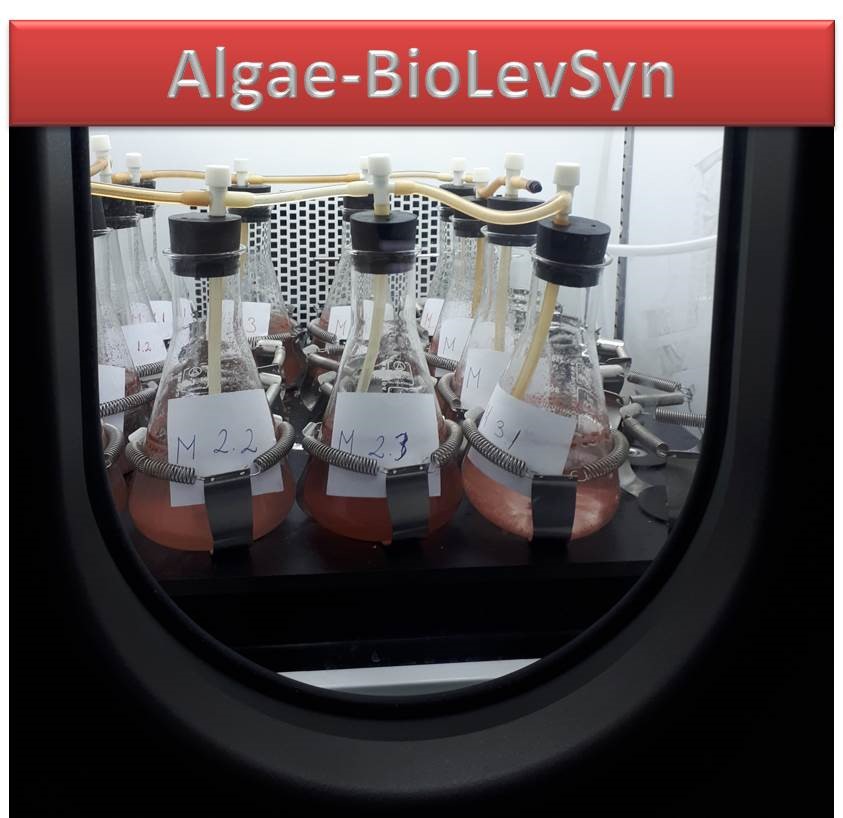
Experimental models of 4 algal strains have been developed in order to select microalgae strain with high lipids and carbohydrate content, capable of growing on glycerin-supplemented nutrient media. Therefore, 2 green algae:Nannochloris sp. andNannochloropsis sp., and two red algae: Porphyridiumpurpurem and Dunaliellasalina were studied. The experimental tests were carried out in triplicate on an Inova 42 R stirred shaker equipped with 16 site, stirring and temperature controller under continuous lighting.
Algal growth was monitored as follows:
- the cell concentration of the microalgal suspension was calculated using the Neubauer camera mounted on a Motic optical microscope with a 3 megapixel high resolution Moticam 3+ camera;
- optical density was measured using the ULTRA 3600 Rigol optical instrument purchased during the project, by reading absorbance at 540 nm (green algae) or 750 nm (red algae). The 4 microalgal species studied Nannochloris sp.,Nannochloropsis sp., Porphyridiumpurpurem and Dunaliellasalina were grown in 3 different media for 7 days. Nannochloropsis sp., Porphyridiumpurpurem were grown in ASW medium, while Dunaliellasalina and Nannochloris sp. were grown in D / 2 medium and BBM growth medium respectively
The polysaccharide content is an intermediate reserve in some algae for lipid synthesis when nitrogen requirements are limited. Carbohydrates tend to accumulate in the stationary phase of algal growth. The highest carbohydrate content of algal biomass was observed for Porphyridiumpurpureum, followed by Nannochloropsis sp., Dunaliellasalina, Nannochloris sp. Under stress conditions the Porphyridiumpurpureum strain has the ability to excrete exo-polysaccharide in the culture medium. Regarding both the polysaccharide and lipid content, the highest percentage was observed for Porphyridiumpurpurem followed by Nannochloropsis sp., Nannochloris sp. and Dunaliellasalina, respectively.. This trend can be explained by the large cell size of the Porphyridiumpurpurem species.
As a result of the very good results obtained in the lipid and carbohydrate content, the following two algal strains were selected for the continuation of the experiments: Porphyridiumpurpureum and Nannochloropsis sp.
The optimization of the culture medium composition to increase the lipid and / or polysaccharide content was achieved by following the influence of NaHCO3 and glycerol content on lipid and / or carbohydrate productivity.
The experiments were carried out in a Grant Bio ES-80 orbital shaker with 30 positions at room temperature and shaking at 100 rpm. The tests were carried out in 100 ml autoclavable autoclaved bottles with an air pump, to which were added 2 ml of inoculum, 50 ml of sterile growth medium, glycerol (0.5 g / L), 0.05 ml trace elements and 0.05 ml of iron-chelated solution under continuous lighting conditions and shaking at 100 rpm at room temperature.
The culture was monitored as follows: Optical density was measured using an Ultra 3600 Rigol optical instrument by reading absorbance at 750 nm for Porphyridiumpurpurem and 560 nm Nannochloropsis sp. Morphology and cell count were studied using a Moticam 3+ high resolution (3 megapixel) Moticam microscope; while the physical and chemical characteristics of the cells were recorded by flow cytometry. After about 7 days of growth, when the culture reached a stationary phase, the microalgae suspension was harvested and then centrifuged (Rotina 380R Centrifuge) at 8000 rpm for 20 minutes. The algal biomass obtained was dried and processed to determine the lipid and carbohydrate content using the TGA lipid analysis technique and the colorimetric method for carbohydrate content. The exo-polysaccharides in the supernatant resulting from centrifugation of Porphyridiumpurpureum samples were precipitated with ethanol in a 1: 1 mass ratio and left for 12 hours at -20 ° C. The white precipitate obtained was separated by centrifugation and dried.
The lipid content of the algal biomass was determined by thermogravimetric analysis. The recorded thermogravimetric analyzes for the Porphyridiumpurpurem strain and Nannochloropsis sp., have the same decomposition profile.The total lipid content ranges from 26% to 41.89% for Porphyridiumpurpureum, the maximum value being obtained for culture medium suplimentated with glycerol. The minimvalue of 26.36% was obtained for the culture medium with highNaHCO3 content. Therefore, a reduced NaHCO3 content leads to an increase in the lipid content in algal biomass.For the algal strain Nannochloropsis sp., the variation in the percentage of lipids is between 52,16 and 40,80 %. It can be seen from that for the medium without NaHCO3, M1, and the glycerin-containing growth medium M5, the lipid fraction is low compared to the NaHCO3-supplemented media for which maximum values of lipid fraction.
The Results were disseminated by one communications at an international conference and one manuscript was sent for publication to an ISI Journal:
- E.-E. Oprescu, C. E. Enascuta, S. Velea, A.-M. Galan, M. Bombos, E. Radu, V. Lavric, Modeling of Porphyridium purpureum growth and production of either carbohydrates or lipids, 4th International Conference on Chemical Engineering, October 31 – November 02, 2018, Iasi, Romania.
- E.-E. Oprescu, C. E. Enascuta, A.-M. Galan, M. Bombos, G. Vasilievici, G. Isopencu, V. Lavric, Evaluation of Porphyridium purpureum and Nannochloropsis sp. for productivity in Carbohydrates and Lipids, summited to jounal REVISTA DE CHIMIE, status: under review.
Phase 2
Title: Conversion of algae biomass into biodiesel and levulinate esters
Period: 01.01.2019 - 31.12.2019
The Objective of phase 2 was the extraction of lipids from algae biomass; conversion in two-steps of algae lipids into biodiesel under heterogeneous catalysts and one step conversion of de-oiled biomass into levulinate esters.
The Activities corresponding to the objective of phase 2 were the following:
A2.1 Extraction of lipids from algae biomass
A2.2 Conversion in two-steps of algae lipids into biodiesel under heterogeneous catalysts
A2.3 One step conversion of de-oiled biomass into levulinate esters
Summary of the scientific and technical report for phase 2
Microalgae have recently attracted considerable interest worldwide, due to their rich valuable compounds composition. From these, pigments, proteins, polysaccharides and lipids, are the most abundant, having applications in cosmetics, human food, and energy industry. By far, lipids are the compounds most studied. The lipids extraction methods reported in the literature includes microwave enhancement, high-pressure homogenization, bead beating, chemical extractions, ultrasonic intensification, water bath and laser treatments. The aim of this activity was the optimization of lipids extraction conditions from wet algae biomass using ultrasonic and microwave intensification. Different extraction parameters such as solvent ratio, biomass initial humidity, ultrasonic/microwave power, time of exposure and temperature profile were tested. The Box-Behnken technique was used to generate an experimental matrix for the most influential parameters upon the extraction yield of lipids.
In this activity, experimental models have been developed regarding the two-stage conversion of lipids from algae into biodiesel on heterogeneous catalysts. In a first step, the algal oil was subjected to an esterification step in order to reduce the acidity to a value below 1 mg KOH / g oil in the presence of the SO42-/TiO2-La2O3 catalyst supported on ferromagnetite. Different reaction parameters have been studied, such as alcohol: algal oil; catalyst mass: algal oil; reaction temperature: reflux; reaction time. The reaction mixture obtained is further used as an intermediate for the transesterification step. The following technological parameters were defined: alcohol ratio: algal oil; catalyst ratio: algal oil; reaction temperature: reflux; reaction time.
One of the most abundant renewable resources with a great potential as raw materials for production of fuels and bulk chemicals are carbohydrates derived from biomass. Among these, esters levulinates have been widely used as solvents and plasticizers in food industry or as fuels additives for transportation. The direct synthesis of methyl levulinate from fructose over solid superacid SO42−/TiO2-La2O3 catalyst was investigated. The influence of different reaction parameters such as reaction temperature, reaction time and catalyst amount was studied. Synthesized compounds were analyzed by GC–MS/MS. Under the best condition the yield in levulinate esters reach the value of 87.52 %. The experimental data obtained were used to estimate the methyl levulinate yield applying multiple linear regressions and artificial neural networks. A comparison of the data obtained with the two methods showed that the artificial neural network is more suitable to estimate de yield. The results obtained from artificial neural networks were in good agreement with the experimental data indicating that artificial neural networks has a good potential in the methyl levulinate yield prediction.
The Results were disseminated by 7 communications at an international conference, 2 manuscripts were published an BDI Journal and 1 manuscripts was sent for publication to an BDI Journal:
- E.-E. Oprescu, C. E. Enascuta, A.-M. Galan, A. Radu, G. Isopencu, V. Lavric, “Extraction of valuable compounds from microalgal biomass. Operating conditions and yield”,“European Biotechnology Congress 2019’, Valencia, Spania, April 11-13, 2019,Abstracts / Journal of Biotechnology 305S (2019) S39.
- G. Isopencu, C.-E. Enascuta, E.-E. Oprescu, V. Lavric, “Study of P. purpureum and Nannochloropsis sp. growth conditions for increasing yields in Carbohydrates and Lipids Production”, 21st Romanian International Conference on Chemistry and Chemical Engineering, 4-7 septembrie, Constanta – Mamaia, ROMANIA.
- G. Isopencu, C.-E. Enascuta, E.-E. Oprescu, V. Lavric, “Symbiotic growth of red microalgae, bacteria and fungi in a discontinuous bioreactor”, 21st Romanian International Conference on Chemistry and Chemical Engineering, 4-7 septembrie, Constanta – Mamaia, ROMANIA.
- E.-E. Oprescu, C. E. Enascuta, G. Vasilievici, C. Calin, C. Popa, V. Lavric, “Conversion of biomass under heterogeneous catalyst into levulinic esters”, “International Multidisciplinary Scientific GeoConference Surveying Geology and Mining Ecology Management, SGEM”, 30.6-09.07.2019, Albena, Bulgaria.
- E.-E. Oprescu, C. E. Enascuta, G. Vasilievici, C. Calin, C. Popa, V. Lavric, “Conversion of biomass under heterogeneous catalyst into levulinic esters”, Conference Proceeding of 19th International Multidisciplinary Scientific Geoconference, SGEM 2019, ISSN: 13142704, Volume 19, Issue 4.1, 2019, pagini 107-114, DOI: 10.5593/sgem2019/4.1/S17.014
- E.-E. Oprescu, C. E. Enascuta, E. Radu, A. Radu, G. Vasilievici, M. Bombos, Synthesis of fuel additives from biomass platform molecules, 9th International Conference of the Chemical Societies of the South-East European Countries, 8-11 mai 2019, Targoviste, Romania.
- E.-E. Oprescu, A. Radu, C. E. Enascuta, G. Vasilievici, E. Radu, G. Psenovschi, V. Lavric, Effect of Temperature and Composition on Viscosity of Different Formulation of Ethyl Levulinate/DieselFuel/Biodiesel, Simpozionul international "PrioritatileChimieipentru o DezvoltareDurabila - PRIOCHEM", 30 octombrie-1 noiembrie, 2019, Proceedings 2019, 29, 120; doi:10.3390/proceedings2019029120.
- E.-E. Oprescu, C. E. Enascuta, , E. Radu, R, Fierascu, D. Bombos, V. Lavric,Synthesis and evaluation of levulinic ester as biodiesel additives, summited for evaluation to jounal Rev. Chim..
Phase 3
Title: Steam catalytic reforming of residual biomass cake to obtain syngas
Period: 01.01.2020 - 31.07.2020
The Objective of phase 3 was the syngas synthesis from residual biomass cake.
The Activity corresponding to the objective of phase 3 were the following:
A3.1 Syngas synthesis from residual biomass cake
Summary of the scientific and technical report for phase 2
Biomass pyrolysis or gasification is recognized as one of the most promising technologies for producing sustainable fuels that could be used for power generation systems or syngas applications. The main advantage compared to the direct combustion is the conversion of low-value feedstock’s to high quality combustible synthesis gas, which, instead of being just directly burnt for electricity generation, is turned into liquid transportation fuels. Therefore, the objective of this activity was to develop a thermodynamic equilibrium model able to simulate the gasification process in a downdraft gasifier. Two biomass samples were used to calculate synthesis gas composition under adiabatic conditions. The generalized equations were obtained by multiple regression analysis to predict synthesis gas composition using elemental analysis and TGA profiles of the biomass. The process of gasification is essentially described through a global reaction that includes all the gaseous species, the biomass and, separately, its moisture content. The equations of mass and energy balance and thermodynamic equilibrium have been implemented and solved in the Matlab environment. Also, an interface was created in order to facilitate data input to program, like ultimate analysis composition, the moisture content or the process temperature. Also, in this interface, the generalized stoichiometric coefficient, resulted when solving the mathematical model, are displayed. The influence of moisture content, biomass composition and reaction temperature over syngas composition was investigated. The experimental data indicate that maxim content in H2 andCO was achieved at 800 oC and moisture content of 30 wt%. The results demonstrate a good potential for the utilization of the extracted algae biomass as feedstock for large-scale production of syngas via gasification.
The Results were disseminated by sending a manuscript for publication in an ISI Journal:
- E.-E. Oprescu, C. E. Enascuta, E. Radu, Prediction of gas composition resulted from biomass gasification using thermodynamic equilibrium model, summited for evaluation to Rev. Chim. Journal.
Oprescu Elena-Emilia, Phd. Chem., e-mail: oprescuemilia@gmail.com
Lavric Vasile, Prof. PhD Eng., e-mail: lavric.vasile@gmail.com